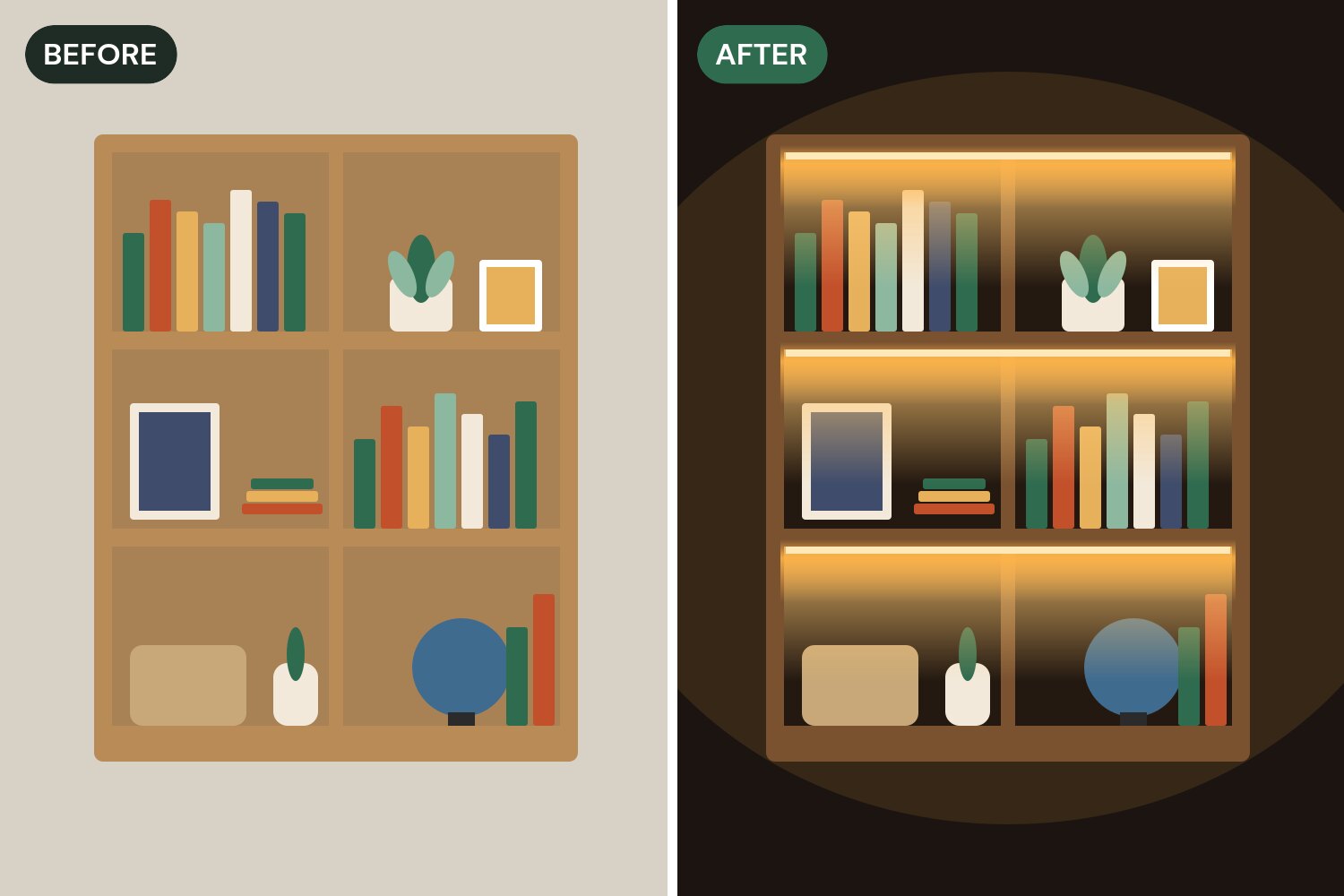
Few upgrades change the mood of a room as much as soft, warm light tucked under a shelf. A glowing bookcase turns an ordinary corner into a feature, and it takes an afternoon and a plug-in LED kit. You do not need to open a wall or touch your home wiring.
This guide shows how to choose the right strip, install it so it looks clean, and style the shelves so the glow shows off what you own.
Why use LED strips on shelves
- Low energy use. According to the U.S. Department of Energy, ENERGY STAR certified LEDs use at least 75% less energy than traditional incandescent lighting and last much longer.
- No rewiring. Plug-in kits run from a small power adapter, so the project is renter friendly.
- Instant atmosphere. Warm light makes books, plants and frames look richer and makes a room feel calmer in the evening.
What you need
- A plug-in LED strip kit with a certified power supply (look for a UL or ETL listing)
- Warm white light, about 2700K, and a high color rendering index (CRI 90 or higher) if you can find it
- Optional aluminum channels with a frosted diffuser for a smooth, dot-free glow
- Isopropyl alcohol and a cloth
- A tape measure, scissors and a pencil
- Cable clips or a small cord cover
- Optional: a dimmer or remote, or a smart plug
Step-by-step installation
Step 1: Measure each shelf
Measure the width of every shelf where you want light. Add up the lengths so you know how much strip you need, and plan where the power adapter will sit, ideally close to an outlet and out of sight.
Step 2: Choose warm light
Color temperature is measured in Kelvin. About 2700K gives a cozy, golden glow similar to a classic lamp. Cooler strips look bluish and clinical on wood and books. A dimmer lets you lower the brightness in the evening.
Step 3: Clean the surface
Wipe the underside of the shelf with isopropyl alcohol and let it dry. Dust and oils are the main reason adhesive strips fall off.
Step 4: Test before you stick
Plug in the strip and hold it in place to check the brightness and color. It is much easier to change your mind before the adhesive is down.
Step 5: Mount the strip at the front edge
Attach the strip to the underside of each shelf, close to the front edge but set back slightly so the LEDs are not visible when you look straight at the shelf. If you use an aluminum channel with a diffuser, mount the channel first and press the strip inside. Only cut the strip along the marked cut lines.
Step 6: Join the strips
Use the connectors that come with the kit to link the shelves, or run a short extension lead down the side of the shelf. Keep the strip flat and avoid sharp bends, which can damage the circuit.
Step 7: Hide the cables
Run the wires along the back or inside edge of the bookcase and secure them with small clips. A thin cord cover painted to match the wall helps on exposed runs.
Step 8: Place the power supply safely
Leave the adapter somewhere with airflow, not buried under books or fabric. Do not coil a strip that is switched on, because it can build up heat.
Make it smart and efficient
Plug the kit into a smart plug and set a schedule so the shelves turn on at sunset and off at bedtime. Many strips use roughly five to fifteen watts per meter, so check the label on yours. Even a long run of efficient LEDs costs little to run for a few hours a day.
How to style the shelves so they glow
- Group items in odd numbers, such as three books and a small plant.
- Mix heights and textures: stacked books, a frame, a ceramic vase and a woven basket.
- Leave some empty space so the light has room to show off each piece.
- Add one or two plants. If you have pets, remember that some common plants, including pothos, are toxic to cats and dogs, so choose pet-safe varieties.
- Keep the back panel in a darker tone if you can, since light and shadow create depth.
Common mistakes
- Buying the cheapest strip with an uncertified adapter.
- Choosing cool white light, which clashes with warm wood and books.
- Mounting the strip too far forward, so the LEDs show.
- Skipping the cleaning step, which makes the adhesive fail.
- Hiding the power supply where it cannot cool.
When to call an electrician
Plug-in kits are safe for most homes. If you want hardwired lighting inside the wall or shelves, or a switch built into the wall, hire a licensed electrician and follow your local code.
Save this guide for later
Frequently asked questions
What color temperature is best for shelves?
Around 2700K is a good choice for a warm, cozy look. Go slightly higher, about 3000K, if you want a touch more brightness.
Can I use LED strips in a rental?
Yes, with caution. Test the adhesive on a hidden spot, or use removable mounting clips instead of adhesive on painted surfaces.
Do LED strips get hot?
They run much cooler than incandescent lighting, but the power supply can get warm, so keep it ventilated.
Want the whole room to feel warm? See our warm lamp lighting guide, or save on energy with the winter heating checklist.